Feeling stuck trying to save your relationship is a common challenge that many face.
It can feel like an endless journey, where reconciliation is always out of reach. This isn't just impatience—it's a subtle trap at work, a lust for the finish line that prevents us from ever reaching it (and makes the journey itself feel like a massive pain in the ass).
**My Marriage Story**
My marriage collapsed. I found a program that helped me, became a coach, and eventually saved my family. Now, I'm sharing the lessons.
Today I'd like to give you something that helped me to transform my reconciliation journey into a highpoint, instead of just an ordeal.
**Why Fixating on the Finish Line Kills Progress**
When we commit to saving our relationship, the intentions are often noble.
We do it for family, love, and the life we'd once dreamed together...
However, fixating on getting back together can backfire. Hard.
I've seen countless men, including a friend who started the program the same time as me, struggle with this.
He was always talking like the finish line was just around the corner, always justifying having it as his only focus...
Only to crash out again and again because his partner pulled away.
It was like the Greek tragic hero, Tantalus - the gods condemed him to stand beneath a fruit tree for all eternity, the fruit always just out of his reach.
He eventually got his reconciliation, but only after he realised - he had to stop reaching. He had to accept it, only then would he get to eat.
So how did he get there?
**The Law of Flipped Expectations**
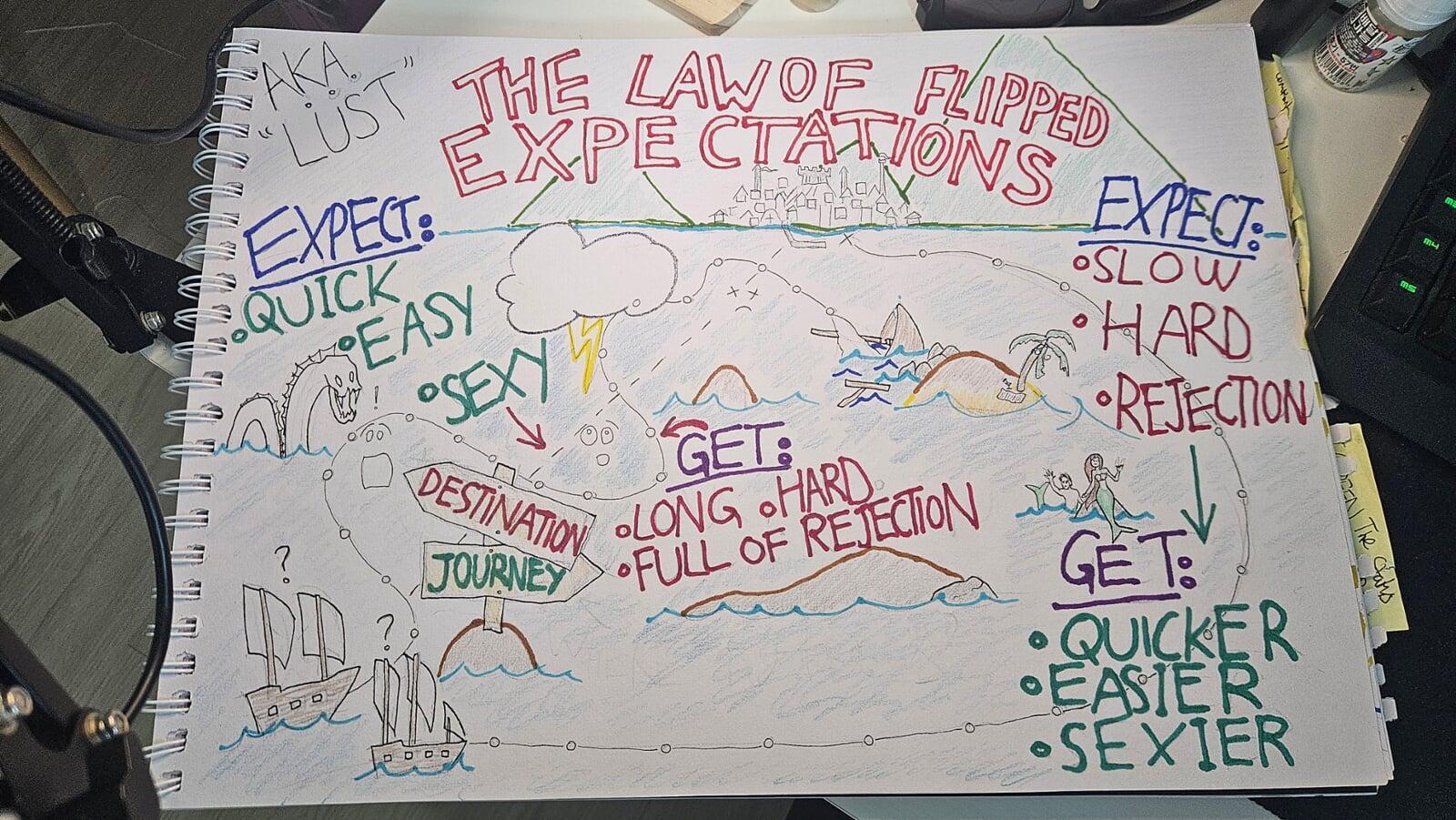
To escape this cycle, we need to understand the "Law of Flipped Expectations." We expect slow, and achieve fast.
We refocus on modest aims, rather than always racing towards the destination.
Consistent efforts and small improvements matter.
In the drawing below, you can see two paths to the same port.
- One ship wants to sail the shortcut to the Destination (on the left)
- The other decides to sail the long way round, accepting the Journey (on the right)
- The ship that takes the shortcut is expecting:
- maybe this can be quick?
- maybe this can be easy?
- maybe this can be sexy (I can look like a stud by succeeding in half the time)?
- The ship that takes the long way round is thinking:
- the going will be slow.
- the going will be hard.
- the going will be full of rejection (hard moments, having to turn back, and delays)
- But what do they each end up getting? The exact opposite of their expectations.
Because expectations shape our focus, where our motivation and effort goes, and how we FEEL along the way.
The captain with the modest expectations will do the right things more often, more consistently, and with more discipline. As a result, they will get there LONG before the other captain does... if the other captain arrives at all.
In a relationship context, this is because our partner can FEEL our motivation. It's written on our faces. If they feel that you're just rushing to get back, they know you're not interested in doing things right, and not interested in doing it for the long haul. You just want the prize.
There's no faking when our motivation is coming from this place.
Hence she'll run a mile. And who would blame her?
**Paraphrasing: A Tool for Progress**
As we've just said it's incredibly important for our partners to see we have the right, modest motivations, it's even more important for us to know: what are some modest steps for us to take?
A step you can take every single time you see your partner, and an invaluable tool along this journey, is the communication skill of paraphrasing.
It counteracts the desire for immediate resolution, immediate agreement, and instead anchors you back in the present.
By using this skill to have meaningful conversations, by understanding and labeling your partner's emotions authentically, you can rebuild trust and admiration over time.
**Practical Steps: L-U-E-C & R Acronym**
1. **Label** - Start by identifying your partner's emotions. "You maybe felt angry / frustrated / confused / pressured / etc."
2. **Understand** - Recognize the interpretations that might have lead to these emotions. "I'd be confused, because why on earth wouldn't ABC if XYZ? And when DEF happened... etc."
3. **Example** - Share a relatable experience or analogy. "I remember when ABC happened and I felt like XYZ." Or an analogy: "It's like you're being treated as a mushroom - kept in the dark and fed bullshit."
4. **Clarify** - Confirm your understanding with them. "Is that kind of it?" or "Could you tell me more how you felt?"
These first 4 steps can be used in a loop, around and around, chatting until you understand, and she feels understood (once she's saying "yeah that's right!")
5. **Recap** - after you've reached understanding, you can use the recap to summarize the conversation, the big picture of what she's been feeling.
It's as simple as that, and it's not a manipulation technique or tactic - it will only work if you're genuinely wanting to listen and help.
**The Power of Modesty and Consistent Action**
By adopting modest expectations and consistent action (like using the paraphrase skill), you will begin to enjoy and take pride in the journey. Embrace the messiness, expect adversity, and relish in modest victories. When reconciliation is perceived as a long, challenging journey, it often arrives quicker than anticipated.
This mindset not only saves marriages but enriches life itself. It applies across fitness, career, and any realm requiring persistent effort.
When you focus on the journey, not just the destination, transformations can begin to occur.
PS - check out the vid on this exact topic, below!
PPS - hopefully what I’ve said here helps you to make sense of wherever you’ve been stuck. If you follow everything in these blogs and vids, and actually put it into practice, you’ll be well on your way already.
Once you’ve done that, and you’re beginning to see some positive signs, that’s where most people realise: it’s extremely challenging to do it alone.
It’s hard to know whether you’re doing everything the right way…
It's hard to stay consistent…
It's hard to know if you’re doing enough to tip the scales…
If you’ve been viewing our stuff for a while, and find yourself in that place, that’s when I'd encourage you to take the next step, and watch our First Step Video.
It's 46 minutes, where I explain how we help guys like you bring their relationships back from the brink.
I'll also explain the three pillars that form the basis of all healthy relationships.
Just understanding these, and keeping them in mind, will be a big first step towards saving your marriage.
Set aside a lunchbreak, or sit in your car, and give it your full attention....
Because this is where you start to turn things around.
Click below to take the first step now.
