
How the "Valley of Despair" kills our future when we give up too soon
Ever feel like your relationship is uniquely broken?
Too much has happened, and now it's beyond repair?
No advice could possibly help?
That feeling becomes a self-fulfilling prophecy: - we can't bring ourselves to take action because... what would be the point?
And it's normal to feel that way. I felt it myself, just 4 short years ago.
You feel like you'd be an idiot unless you listen to your gut and throw in the towel. You don't want to try and fail again...
Only 90% of the time - the feeling is dead wrong.
I'm glad my gut told me to try anyway, and doubly glad that I found exactly what I needed to push through that feeling.
In the hopes that it might give you the same push, here's what helped me:
1 - Understanding that the Feeling is Universal
We might think our situations are unique, that nobody could help. This feeling is actually the most common trap people fall into.
We feel alone because: how often do the people who "make it" want to talk about the time when they hit rock bottom?
Most people only want to share their successes. Their victories.
- CEOs want to act like the 6 failed companies they started before never happened...
- Star players don't want to talk about the teams they didn't make...
- Musicians don't want to listen to their albums that flopped...
- Directors would rather forget the movies that didn't even make back their budgets...
- ...and perfect twenty-year married couples don't talk about the few years they spent having tearful, late-night talks about calling it quits.
So for the rest of us, the loneliness, the feeling of being "the only person who's ever had a situation this impossible," persists.
So if that illusion is actually normal and commonplace, what's the reality that the successful few recognise?
2 - Seeing the Reality
Reality: every "overnight success" took years of painfully figuring it out. We just don't see that part: we only witness the end result.
Reality: every "happy marriage" probably went through some dark and trying times, where at least one of them wanted to give up.
The hidden reality - that it's normal, that it's fixable, that it's not unique - doesn't change how it feels to actually be in that low-point. But understanding the journey, the different paths and where they lead, can really help (it helped me - a LOT!).
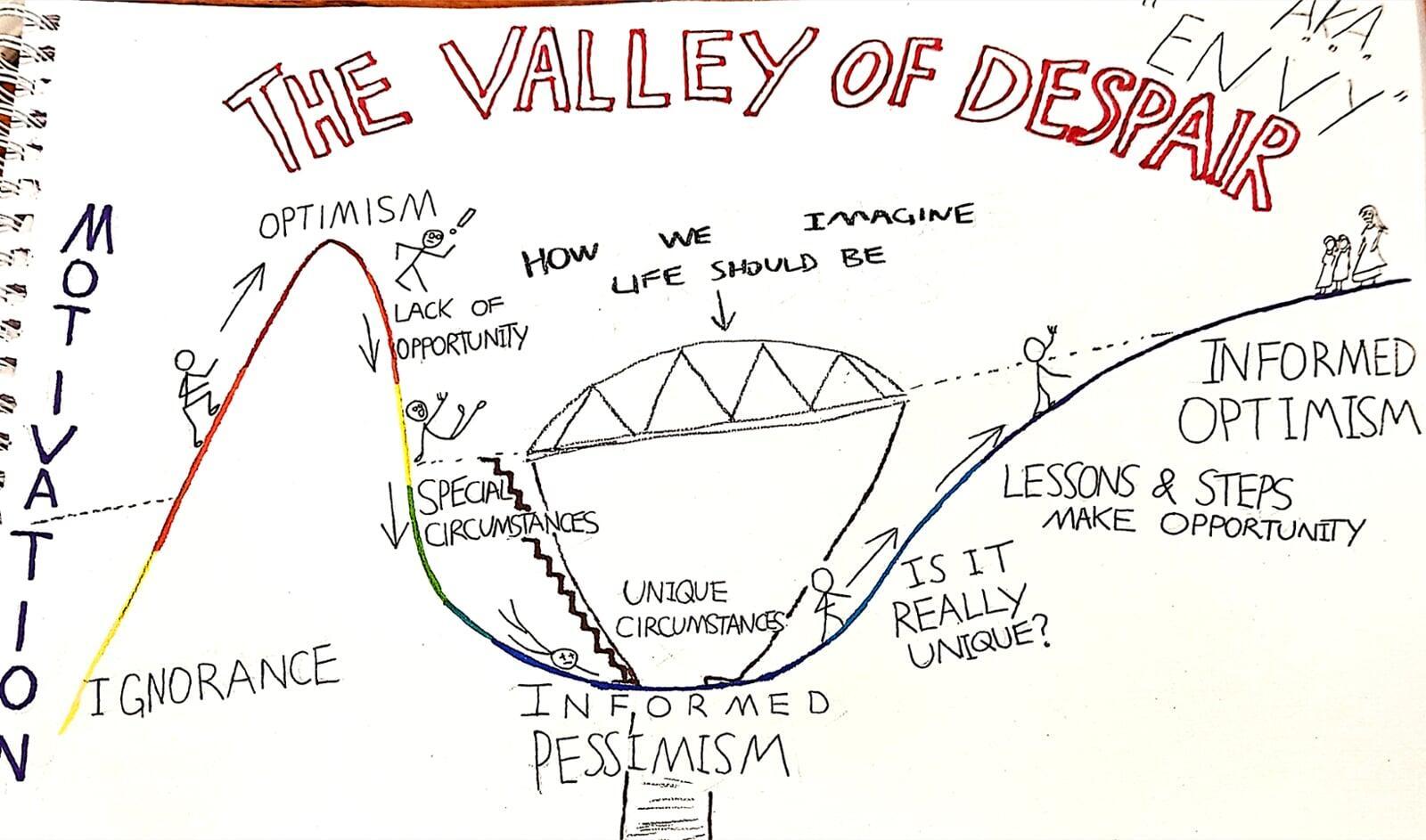
That journey is perfectly covered by a concept from psychology and behavioural science - the Valley of Despair.
3 - Confronting the Valley of Despair
When all hope seems lost, you’re actually entering an inevitable part of any worthwhile journey - the Valley of Despair:
- Whether it's a new sport, a career, or a serious relationship, we always start out with optimism fueled by our relative ignorance. This is the honeymoon period, and things are looking great! Excitement and motivation are on the rise. Maybe you get married, have a bunch of kids, and start to build your lives together...
- But we don't know what we don't know, and we eventually reach the peak of uninformed optimism...
- No matter how perfect things were in the beginning, eventually differences emerge between the two of you. Maybe she doesn't tell you everything anymore. Doesn't want dates. You can't agree on big ticket plans or family budgets, so you let arguments sit in a stalemate, or a win-lose arrangement...
- Everything seems fine on the surface for the most-part, but you've begun the descent into the valley. You're starting to see tiny crack form, and motivation slowly gives way to just hoping for the best, or sweeping things under the rug...
- Then, some really special circumstances begin to arise. Maybe one of you becomes depressed. Or perhaps she starts moving in her own direction, making sweeping changes. You don't know what to do, but maybe it will work out on its own eventually...
- But as more and more challenges crop up, suddenly things look uniquely broken. Now she's moving out, or seeing someone else, or talking openly about divorce. Her motivation to work on things is close to zero, and your own motivation comes in fits and bursts... then flatlines. This is the bottom of the Valley.
- You've reached "informed pessimism," - where you think you know all that there is to know, and it's ALL BAD.
4 - Adjusting My Expectations
When we marry, we kind of expect that we'll talk it out, and cross whatever bridges when we come to them.
That works just great in the early years, when there's no kids in the picture, and life hasn't begun to wear us down. At that stage, we still deeply admire one another, we can talk about everything without fearing our partner's reactions, and we're still heading in the same direction...
But when we get to the bottom of the Valley... there's no bridge. It's just a ravine, bottomless, yawning, impassable. FUCK.
This broken expectation can lead us to think - "I'll just skip-on out of here then. It's the end of the line, I'll go up these steps, back to the path, maybe meet someone new..."
The grass sure looks greener over there, after all.
I had to realise, as I've helped many others to realise - the grass only looks greener because it's equally full of shit.
And if we take the stairs out of there, we only end up facing the same climb and subsequent Valley on a new journey. Only now, we're older, we've lost more, we've suffered more, we have more baggage, more kids, more complications, and the same problems as we had before.
4 - The Road Out is Not So Bad
Instead of abandoning the path, I decided to stick to it. Like I said - my gut told me to at least TRY.
And I soon found plenty of evidence:
- The road out was a lot clearer than it appeared.
- The climb towards "informed optimism" involved focusing only on what I could control. My actions, words, beliefs, and the environment I created.
- My situation was just like what hundreds of similar guys had faced, and overcome.
- I could find plenty of guidance from coaches, courses, and books that talked about situations exactly like ours.
- I could start implementing small, actionable steps.
- Slowly but surely, opportunities started coming my way again.
5 - I Could Become the Hero of My Own Story
We start to focus more and more on the things we control, instead of the things we don't (what others do, what the world does), and feel a sense that we can slowly change and improve. Like a hero on a journey, levelling up. That becomes fulfiling on its own, long before actually getting everything we want back the way we'd prefer it.
To become the hero:
- We embrace love towards our family and partner, despite the challenges. Love is a verb, an active choice we make, not just a feeling.
- We bring our best-selves to each interaction, like we did when we were dating (and not waiting for our partner to reciprocate - we remember everything they've done for us in the past instead).
- We find joy in the journey, enjoying all the small learnings from every book, podcast, and lesson, knowing that we'll be ready for the future, regardless of what happens.
- We focus on our responsibility, learning how to be a better partner and parent, and knowing we'll be out of the Valley eventually.
Takeaways: The Illusion of Uniqueness
Our feelings of hopelessness in our relationships are only ever an illusion.
If it's truly hopeless, trying will teach us so much, and carry us so far, that it's always worth the Journey - muscles grow from lifting what we think we can't, again and again, with new techniques we learn along the way.
And it's not just about getting our partner back, but about becoming the person we ought to be. We create a life that's better and happier, whether or not our partner chooses to become part of it again.
If this has given you back even a flicker of hope, keep in mind: the grass is greener where we water it. By actively engaging choosing the journey, you’ll find more hope and understanding in ways you never expected. Keep walking through that Valley.
And remember, even small steps are progress on the path. Keep going!
And stay awesome.
If you find yourself there, I want to encourage you to take the next step, and watch our First Step Video.
It's 46 minutes, where I explain how we help guys in your exact situation.
I'll also explain the Three Pillars - understanding will be a huge step towards saving your marriage.
Set aside a lunchbreak, or find a quiet corner, and give it your full attention... because this is where you start to turn things around.
Link is below.