
Is your relationship unfixable? Beyond saving?
Often good, big-hearted, hardworking guys still get blindsided in their relationships because: it feels like the relationship’s just broken, and NOTHING could fix it.
I want to share some of the secrets I’ve learned that, from the literal hundreds of cases I’ve seen, can give pretty much ANY situation a shot at a cure.
Through my own separation back in early 2022, the program I joined, our eventual reconciliation, and then being scouted as a coach and helping hundreds of guys in that same program, I've had lots of practice helping to fix these impossible seeming separations.
I'm going to explain seven steps to fixing the unfixable, starting with a new perspective, and ending with a path forward that's as clear as day, that you can actually start to walk today.
1 - Understanding the Valley of Despair
This is going to be a long first section, but bear with me. I’m giving you exactly how I think about this stuff.
We all start out in our marriages with a beautiful kind of blind optimism.
Motivation runs high:
This woman is different. You can see a future together.
Before you know it, it’s all happening. Big wedding. Honeymoon. Buy a house.
Kids come along, and cement it all even further.
That optimism is natural, because we’re in the easy part - when safety and admiration and alignment (the essential pillars of any relationship) come to us without much effort. We often don’t know, or need any high-level interpersonal skills. We’re at the stage of “uninformed optimism.” We just don’t know what we don’t know yet…
Then the enemies show up:
Entropy eats away at the edges. Entropy = the tendency for all things to move towards chaos unless they’re actively restored. Skeletons emerge from the closet. Accumulated arguments that were swept under the rug over the course of years. And all the while, work, financial, and parenting pressures accelerate the decay…
Confirmation bias creates hard differences between partners. Confirmation bias = the tendency for humans to selectively and subconsciously find more evidence to support existing beliefs. Mindsets, already drifting apart through entropy, calcify in place, until those differences become entrenched battle-lines…
The Deceivers infiltrate on either side of the trenches. Deceivers = unhelpful beliefs and mindsets that drive us towards fight or flight, sad or mad. We cling to our desires, our lines in the sand, even as it feels like they’re slipping out of reach, fuelling desperate moves and making conflict inevitable.
In this high-conflict environment, Safety is the first thing to break.
Safety = the belief that if we express, if we speak, good things can happen. Understanding can be reached.
With the enemies running unchecked, this feeling of emotional and psychological safety breaks.
Then, even as the guns fall silent across the trenches (because nobody’s talking or expressing their emotions beyond the surface level), even as it seems that peace might return… it’s just the calm before the final storm.
Without safety to talk about our problems, there can only be anxious waiting, as hope slowly drains away from both sides. On a long enough timeline, unless the real enemies are identified, and fought, there is no hope.
Entropy WILL win out.
The centre cannot hold.
That’s when we find ourselves in what I call the "Valley of Despair." It's that point where you realize - you can't do anything to positively impact the relationship.
Special circumstances make your situation feel different, and you ultimately feel like everything’s uniquely broken. It’s like “no one could fix this shit.”
Motivation hits rock bottom. You have reached the stage of “Informed Pessimism.”
Most people escape at this point, imagining the grass is greener on the other side, only to fall into another valley, another relationship, destined to fail the exact same way.
Commonly quoted estimates derived from CDC data show:
41 percent of first marriages end in divorce
60 percent of second marriages end in divorce
73 percent of third marriages end in divorce
3 years average between subsequent marriages
8 years average marriage duration
Combine that with a decline in the likelihood of remarriage with advancing age, and this becomes a game with VERY few shots at goal.
But the grass isn’t greener. The exact same enemies await, unless we, or our partner, has the skills to combat them. By jumping ship, we’re just heading back into uninformed optimism.
So if the Valley of Despair is just a trap, a trick, an illusion… why does it feel so legit?
When things feel impossible, it's easy to think our problems are different. You might be thinking:
There were none of the three A's—no abuse, addiction, or adultery from your side.
You’ve been paying the bills, being a good dad, showing up…
But there’s still total resistance towards reconciliation.
It’s like a wall is up, and behind it, huge changes are proceeding at a breakneck pace.
This feeling of uniqueness is a common trap, whispering: "you might as well give up." But this is a universal human experience.
We CAN reach that place of informed optimism.
We CAN walk out of the Valley of Despair, and never need to jump back to the start.
Even if we leave the goal at a modest: “don’t die alone and unloved,” it’s already quite a compelling argument for learning how to master those relationship skills.
But when we consider the increase in healthy life expectancy: 15–30% lower mortality VS unmarried, divorced, or widowed men, it becomes more compelling still.
And forgetting the statistics entirely, when I tell you from my perspective: waking up together, hitting the mattress, then the gym, then the cafe, and chatting like a pair of newlyweds about all the things we’re enjoying working on…
I can tell you the grass is greenest where you consistently water it.
Breaking Down the Illusions
One reason the struggle feels so real, and so isolating? Survivorship bias.
We only hear about visible successes or dramatic failures. The vast majority of stories, the ones where people ended up in hopeless places, without a catastrophic collapse to excuse it, or a heroic overcome to brag about… these stories just don't get told.
The truth is, most failed marriages happen due to a lack of safety, admiration, and alignment, compounded by time.
Narrative fallacy also plays a role. We prefer clean stories with clear cause and effect: "He did this, so we divorced."
But real life is multifactorial, full of randomness, mixed signals, and nothing happens in a linear fashion.
Inside the communities I've coached, people are busy breaking down the real reasons. Understanding that letting the pillars of safety, admiration, and alignment collapse is what leads things to spiral.
This understanding is the beginning of the next stage: informed optimism – seeing the real narrative, allowing us to walk out of the valley, realizing the situation wasn't unique nor unfixable.
2 - Focus on Becoming Over Static Self
If you've stopped letting the “unique” situation paralyze you, your next step is to make a fundamental shift in how you define yourself: Focus on Becoming Over Static Self.
Clinging to a static self ("I'm just a provider," "I'm not good at emotions") keeps you stuck.
“We can't solve problems with the same thinking that created them” - Albert Einstein
Focus on becoming whoever you need to be. For years, I played with my phone at the dinner table like a fucking zombie.
When my wife left, I stopped saying, "I am just this way," and started asking, "Who am I becoming?"
That meant working smarter, cutting distractions, and putting time into my growth. Not just for what I wanted, but to help my partner believe things could change.
A static self has no trajectory; if you believe people can become, and you start becoming, she can believe it too. You are what you do repeatedly, and she will see it eventually.
Your identity is your power. Stop waiting for things to be perfect; start perfecting things.
3 - Mythologize Your Personal Transformation
Once we start figuring out what changes we want to make, who we’re becoming, we want to lock the changes in.
To do this, you need to Mythologize Your Personal Transformation. Write your own epic; make your changes legendary. It’s crucial to acknowledge and celebrate your personal growth.
This isn't deluding yourself; it's solidifying your new Becoming Self, proving your efforts are significant.
I contrast my old self—the dirtiest metalhead, filled with self-pity and no direction—with my new self: consistently showing up, knowing where we're headed, building mutual safety, admiration, and alignment. I mythologize all of that.
Perhaps the simplest way is by journaling. Grab yourself a small diary and pen, or use a note-taking app on your phone (e.g., workflowy, samsung notes, evernote, whatever).
Don’t overthink it - just remind yourself of the steps you’re taking, and connect them with whoever they’re helping you to become.
By writing it down, you prevent the erosion of memory (entropy) from stealing your wins.
When we write our next entry, we read the last as well, and elaborate on our old thinking. After all, we need to be reminded more than we need to be taught.
And this is basic, and it sounds too simple, but it’s anything but: it’s the mechanism by which all book learning and scholarship is done - summarisation and the act of writing has a profound learning effect, and learning is what ultimately leads to behaviour change.
The fastest way to save your relationship is with a pen in your hand.
So we get that by crafting your own heroic narrative, you strengthen your new becoming self, gaining intrinsic motivation (motivation that comes from who you’re becoming, not from outside rewards or from your partner). But what if feelings of unfairness or comparison (seeing the greener grass) poisons your resolve?
4 - Choose Love Over Envy
There's a way to neutralize that destructive emotion: Fight Envy with Abundant Love.
Envy tells you - others have it better. Other people’s situations are easier, which is a false comparison. We are all walking at different points on our own journeys.
Instead, what helped me was: to cultivate love as a thriving, internally sourced mindset where my cup could overflow. I gave safety, empathy, and understanding, without expecting anything in return.
This counters her ingrained confirmation bias (our tendency to stack evidence for existing beliefs - one of the enemies) by showing her something consistent, genuine, and surprising.
Not only does this gradually influence how she sees you, but it helps YOU to feel better right now. You’re focusing only on what you control (yourself), and you’ll feel better, calmer, and happier in the process.
When my wife's friends encouraged her to move on, instead of allowing resentment, I focused on what I could do:
I continued to be a great co-parent and a stable presence.
My consistent, self-motivated actions demonstrated exactly what I said I was becoming.
As she slowly came around, her friends did too; in the end, they just wanted her to be happy.
Choosing abundant, self-sourced love disarms comparison, kills the grass-is-greener, and reopens the door to genuine connection. But how do you start to communicate these deep transformations to a skeptical partner, allowing them to believe your changes are real, not just an act?
5 - Master the "Contrast Skill"
Once the changes are true (because there is no faking it), you Master the "Contrast” Skill. This is where we learn how to artfully contrast our old static self versus our new becoming self.
This addresses her skepticism and confirmation bias, by demonstrating your understanding of her past pain and your current growth. It’s powerful self-deprecation, paired with genuine change.
The acronym I use to remember this one (and practice it with friends, colleagues, and family members): OS.D.NS.I
That’s Old-self, Development, New-self, Intentions.
For example:
OS / Old-self:
Riffing off something our partner has said, we highlight understanding of
what our old static self would have done
why we would have done it,
and why it wasn’t helpful / how she might have felt.
“Before, I would've gotten defensive at the first sign of upset, argued, and driven us both nuts.”
D / Development since:
We briefly, without bragging, explain how our thinking has developed since then.
“Thankfully, I learned defending myself wasn't necessary; you weren't attacking, just explaining how you felt. By listening, you'd feel a bit better.”
NS / New-self:
We highlight how we want to show up now - who we’re becoming.
“So now, thank God I can just listen better and try to understand things first…”
I / Intentions:
Here we connect the new becoming self to our new balanced intentions:
What’s in it for her
what’s in it for us
why it’s just aligned with the kind of guy you want to become.
“Not just to get back to good, but because it's so much better for all of us when we have safety to talk about stuff. We can figure things out eventually that way.”
This skill is not just a tactic to trick your partner - it would never work long-term if it was.
It requires real changes to take place first. When genuine, it chips away at confirmation bias, creating space for deeper connection.
But when we’re slowly headed in that direction, how do we create a relationship thriving on mutual respect and shared purpose, where partners choose to be together again out of genuine want, not need?
6 - Striving for Interdependence
You Strive for "Interdependence.” Build a relationship where both partners choose to thrive together.
Most relationships have some element of unhealthy codependency (two people needing each other), and eventually when those needs are consistently not being met (safety, admiration, and alignment pillars have collapsed), one partner moves towards selfish independence.
At this point, the partner who is being left behind tries to pull their partner back, which only makes their newly-independent partner more determined to leave. The abandoned partner ultimately finds themself in the Valley of Despair, and gives up, looking for the grass-is-greener.
Interdependence on the other hand, is two independent people aligning on shared goals, contributing from an overflowing abundance. This is probably what you looked like when you met. When you started out. The good news is - you can get back here, and stay here.
Essentially, you give her the freedom to decide, focusing your independent will on becoming irreplaceable, and offering interdependence, rather than staying dependent and needing to pull her back in.
This inspires her own ongoing journey.
I knew true reconciliation meant my wife choosing to come back, not me begging her. I focused on building my own 'overflowing cup.' When she saw I was happy and thriving regardless of what she was doing, and I respected her independence, she felt safe, empowered, and that she was being given enough time.
That meant that our diverging paths could meet again, without forcing it. We could rebuild the final relationship pillar - Alignment.
But what do we need to sustain us for however long it takes for her to see this vision of interdependence?
7 - Embodying the Guardian Identity
A lot of identity stuff in this one, just like when we talked about the becoming self over the static self, but identity is THE crucial element for walking out of the Valley and seeing the other side.
When we make something our identity, we can keep it going long-term.
And we want one aspect of our becoming self to be - I’m the guardian of safety, admiration, and alignment in all of my relationships. It’s on me.
Essentially - I can carry the team until they get their groove back (and if you can really do this, chances are that they will).
The Guardian archetype is not something we pulled out of a hat - it’s one of the archetypes from Jungian psychology, and pointed to in the work of Joseph Campbell (The Hero With a Thousand Faces). Essentially the Guardian is what stands at the threshold and guards it, with tests for the heroes.
For our purposes, we are guarding that threshold so that others don’t have to. Our role is to protect the relationship's pillars – Safety, Admiration, Alignment – from entropy (tendency towards chaos) and confirmation bias.
We keep these enemies at bay, giving our partner a chance to regain normalcy in her life. To get out of the trenches the two of you have built, and stop the fighting.
To that end, we source what we need from within, not seeking external validation or pointing the finger of blame.
Like we talked about in Step 4, this hero archetype chooses to love, despite whatever others are doing. Love is a verb - a doing-word. It's not a feeling. That means that love is a choice.
You can love, understanding the thoughts behind her feelings (even if you don't agree with all the conclusions right now).
This is what ultimately allows us to put the pillars back together, when she’s ready, by her own choice, and in her own time.
Conclusion: Becoming the Hero of Your Journey
If you are facing that feeling of uniqueness and hopelessness, you can remember these seven steps.
Your situation isn't unique, and you do have the power to change course. By focusing on becoming instead of remaining static, by mythologizing your journey, by choosing to love, by mastering the contrast skill, by striving for interdependence, by embodying that guardian identity, you can keep going... and move out of the Valley of Despair.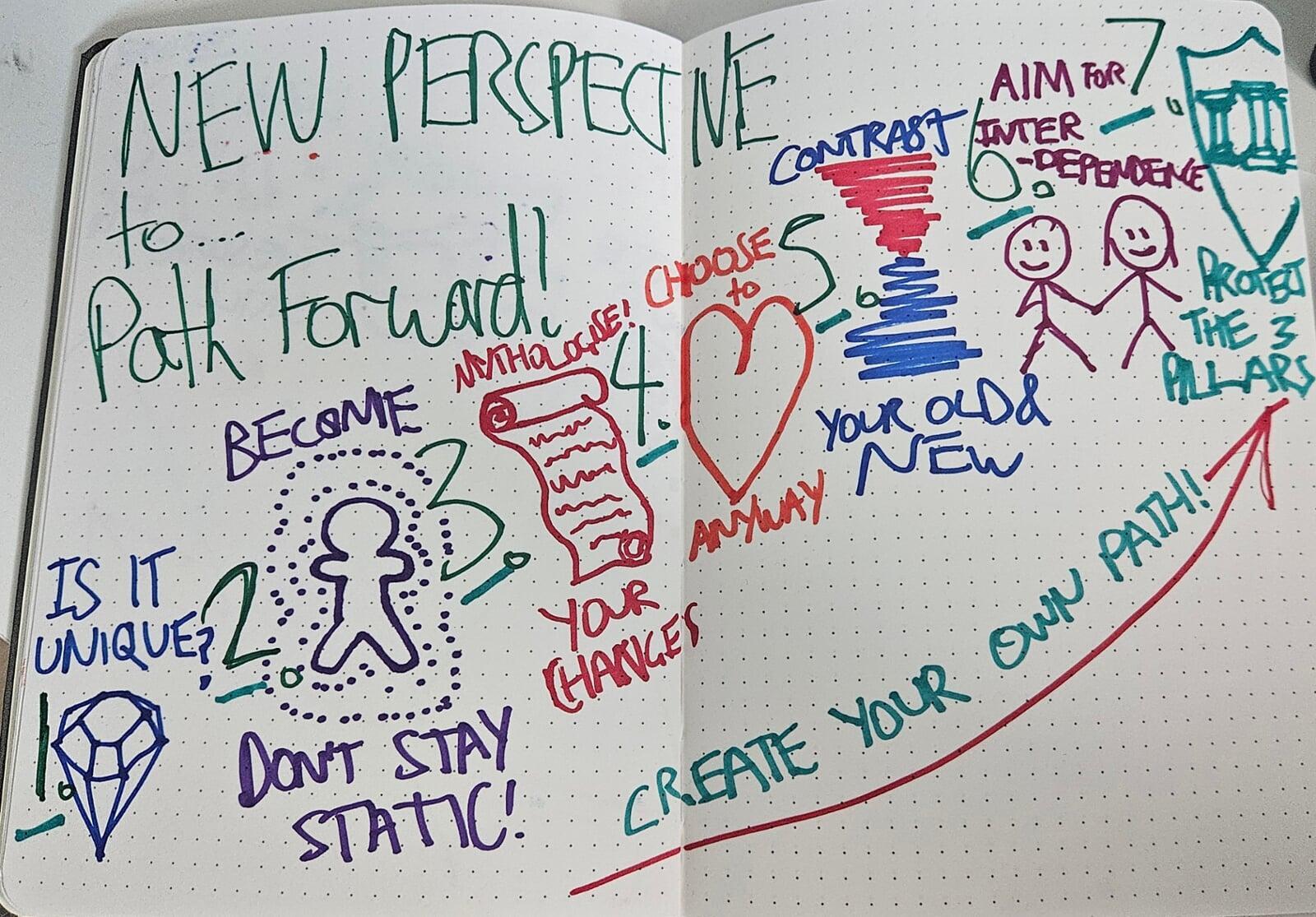
This isn't about quick fixes; it's about lasting change that makes you irreplaceable. Not because of who you are, but because of who you are becoming.
If I've given you value here, check out that link in the description for a free resource that will help you on your journey. Remember, just keep walking.
PPS - hopefully what I’ve said here helps you to make sense of wherever you’ve been stuck. If you follow everything in these blogs and vids, and actually put it into practice, you’ll be well on your way already.
Once you’ve done that, and you’re beginning to see some positive signs, that’s where most people realise: it’s extremely challenging to do it alone.
It’s hard to know whether you’re doing everything the right way…
It's hard to stay consistent…
It's hard to know if you’re doing enough to tip the scales…
If you’ve been viewing our stuff for a while, and find yourself in that place, that’s when I'd encourage you to take the next step, and watch our First Step Video.
It's 46 minutes, where I explain how we help guys like you bring their relationships back from the brink.
I'll also explain the three pillars that form the basis of all healthy relationships.
Just understanding these, and keeping them in mind, will be a big first step towards saving your marriage.
Set aside a lunchbreak, or sit in your car, and give it your full attention....
Because this is where you start to turn things around.
Click the link below to get started.